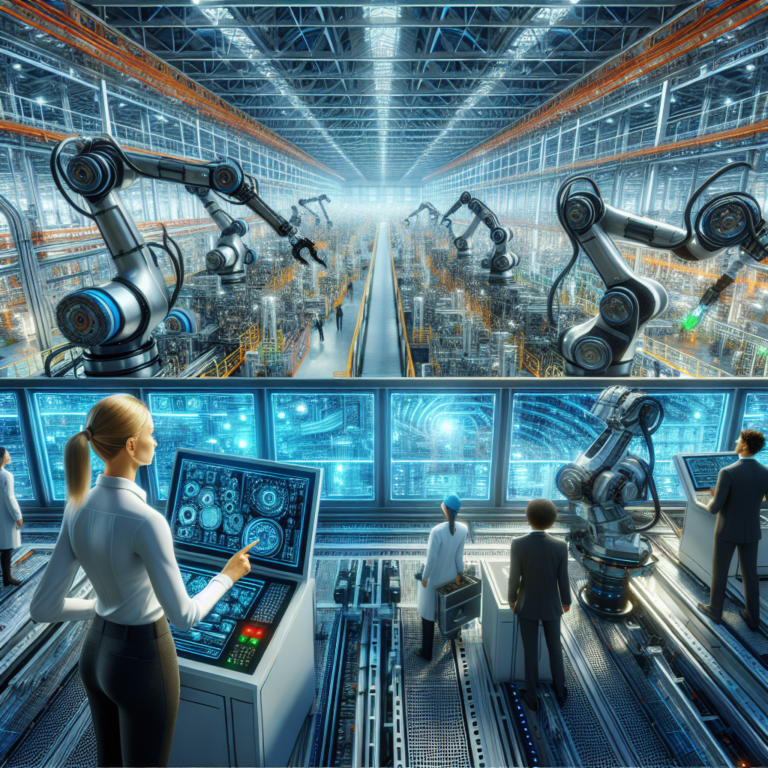
In the world of industrial automation, innovation is everything. The need to continually advance technology has never been more crucial, as businesses strive to streamline operations, respond to changing market demands, and maintain competitiveness in an increasingly automated world. That’s why I was intrigued when I noticed Mujin’s recent website refresh designed to showcase the ever-evolving MujinOS platform. This update is more than just a new look—it’s a strategic move to place MujinOS at the forefront of the next industrial revolution, making it easier for businesses to harness cutting-edge automation tools. Let’s explore what MujinOS is, why it matters, its features, and how your business can implement it in a way that truly transforms your operations.
Table of Contents
- What is MujinOS?
- Why is MujinOS Important?
- Key Features and Benefits
- How MujinOS is Transforming Industries
- Real-World Applications
- Actionable Steps to Implement MujinOS
- Summary
- FAQs
- Sources
What is MujinOS?
MujinOS is an advanced, robotics-oriented operating system engineered to be the brains of the autonomous industrial revolution. Instead of managing basic workflows or acting as just another control board, MujinOS acts as a centralized, intelligent platform that manages, controls, and optimizes the actions of robots and entire automated systems. Its focus isn’t just on movement or task execution; it’s about orchestrating complex processes with intelligence, analytics, and adaptability. MujinOS bridges the gap between software and hardware, centralizing command, real-time monitoring, and learning capabilities in one robust, extensible platform.
Unlike standard PLC-driven automation environments, MujinOS is built from the ground up to handle high levels of complexity—think of multi-robot systems, changing workflows, and the requirements of modern data-driven manufacturing and logistics. It transforms how companies deploy robotics: no longer are you managing disparate, disconnected bodies of software, but instead, integrating them into a single unified system. What this means for businesses is higher efficiency, more flexibility, and a faster path to automation ROI.
Why is MujinOS Important?
The global drive toward automation is relentless. Enterprises are pressured to reduce errors, speed up production, and cut costs—all while improving quality. However, many companies struggle because typical automation software is fragmented, hard to scale, expensive to maintain, and quickly becomes obsolete in the face of rapidly changing demands. MujinOS aims to solve these core pain points.
Its importance lies in the following:
- Unified Intelligence: MujinOS centralizes the management of multiple robots and automated systems, creating a “brain center” for operations.
- Accelerated Innovation: Because it integrates seamlessly with new technologies, it enables businesses to adopt new solutions without starting from scratch.
- Enabling Industry 4.0: MujinOS’s built-in analytics and real-time data collection are crucial tenets of the smart factory vision.
- Simplified Operations: With a user-friendly interface and powerful automation logic, non-experts can configure complex workflows and automation tasks.
As noted by Automation.com, businesses that successfully deploy next-generation automation platforms like MujinOS report improved up-time, better asset utilization, and a dramatic reduction in manual intervention.
Key Features and Benefits
- Real-time Control: MujinOS offers immediate awareness and command over every connected robot, conveyor, or smart machine in your production line. This means you can spot bottlenecks, dispatch maintenance alerts, and optimize parameters on the fly.
- Scalability: Whether you’re automating a single line or an entire warehouse, MujinOS expands with your business, from proof-of-concept to full-scale smart factory. Its modular architecture allows you to bolt on new robots or tools as your business evolves.
- User-Friendly Interface: The recent website and UX refresh have made it simple for users at all levels—from engineers to operators—to understand and leverage the full capabilities of MujinOS. Advanced visualization, intuitive dashboards, and drag-and-drop programming lower the learning curve.
- Enhanced Safety: Embedded safety features help reduce accidents and downtime, while maintaining necessary compliance for high-risk industrial environments. Automated obstacle detection and emergency protocols are standard.
- Cost Efficiency: By automating complex and repetitive tasks, MujinOS reduces the need for human intervention, slashing both labor costs and the risks/costs associated with manual errors or rework.
- Data Analytics and Reporting: Collects, analyzes, and visualizes performance metrics in real time. This enables predictive maintenance, data-driven optimization, and long-term strategic planning.
- Seamless System Integration: MujinOS works with a broad range of equipment, robots, and ERP/MES software, preserving your previous investments and creating a “best-of-all-worlds” automation environment.
How MujinOS is Transforming Industries
The impact of MujinOS isn’t limited to just manufacturing plants—it’s found across the broad spectrum of industrial sectors. Here’s a look at where MujinOS is making the biggest impact:
- Manufacturing: In factories, MujinOS orchestrates the activities of multiple robots performing tasks such as assembly, welding, painting, and inspection. By doing so, it boosts productivity, minimizes errors, and creates a more agile response to shifting orders and SKUs.
- Warehousing and Logistics: Automated picking, sorting, and transport require split-second decision-making and seamless collaboration between heterogeneous machines. MujinOS coordinates fleets of robots and conveyance systems to optimize material flow and order fulfillment, meeting e-commerce demands with speed and accuracy.
- Automotive: As one of the most automation-heavy industries, automotive plants rely on MujinOS to connect legacy robots with new ones, enabling smarter, more flexible production lines capable of handling rapidly changing batches and customizations.
- Food and Beverage: Robotics in food processing must meet strict safety and consistency standards. MujinOS provides traceability, hygiene controls, and efficient handoffs, which are particularly valuable in pick-and-place or palletizing applications.
- Pharmaceuticals: Accuracy and repeatability are paramount. MujinOS brings real-time monitoring and intelligent adaptation to pharma packaging, sorting, and handling—reducing waste and improving regulatory compliance.
The adaptability of MujinOS means that as industries evolve—or as unprecedented challenges, such as global supply disruptions, arise—the system can be updated, reconfigured, or expanded rapidly without major capital reinvestment. That flexibility is a major advantage in today’s unpredictable environment.
Real-World Applications
The true power of an automation platform lies in its use cases. Here are several real-world situations where MujinOS has made a tangible difference:
Automated Material Handling at Scale
A major logistics player needed to increase the speed and accuracy of its order fulfillment in a huge distribution center. Prior solutions could not keep up with the thousands of SKUs, unpredictable orders, and the demand for near-instant shipping. By adopting MujinOS, the facility orchestrated more than 100 robots—pickers, movers, and sorters—that now operate in perfect harmony based on real-time data from the warehouse management system. Order errors dropped drastically, and throughput nearly doubled without additional labor costs.
Flexible Assembly Lines in Automotive Manufacturing
An automotive OEM facing rising demand for customizable models upgraded their assembly line from fixed-scope robotics to MujinOS-controlled smart robots. With MujinOS, each station could dynamically adapt to the car configuration in progress, pulling the right tools, components, and instructions from a central plan. This flexibility reduced both downtime for retooling and the risk of error due to confusion about model-specific steps.
Food Industry Palletizing and Traceability
In food and beverage packaging, traceability is essential. One multinational food processor integrated MujinOS-powered robots for sorting and palletizing fragile packaged goods. The added benefit: every movement and transaction was logged by MujinOS, creating a transparent digital trace all the way to the distribution center. The plant met stringent safety certifications with ease, while also seeing a measurable reduction in damaged goods.
Pharma Sorting and Packaging Precision
In a tightly regulated pharmaceutical facility, MujinOS managed a combination of robotic arms and automated conveyors to sort pill bottles, attach labels, and prepare shipments. The system’s live analytics enabled predictive maintenance, minimizing costly downtime and product loss due to equipment failures. Post-implementation analysis revealed a nearly 40% reduction in overall operational costs.
Actionable Steps to Implement MujinOS
For businesses considering the transition to MujinOS-powered automation, a robust plan is key. Here’s a roadmap to help with the process:
- Assess Your Business’s Automation Landscape: Document your current processes, identify inefficiencies, bottlenecks, and areas with high error or labor costs. Be honest about legacy technologies and integration obstacles.
- Set Clear Goals and KPIs: Define what you want to achieve with automation—greater throughput? Lower scrap rates? Faster order fulfillment? Tie these goals to measurable metrics so you can gauge MujinOS’s ROI clearly.
- Reach Out to Mujin Experts: Even if your IT team is savvy, working with Mujin engineers or certified automation consultants will accelerate a smooth rollout and help avoid hidden pitfalls.
- Develop a Pilot Program: Start with a pilot project focused on a single line, process, or cell. Use this as a sandbox to test integration, train staff, and gauge performance improvements.
- Invest in Training: MujinOS’s user-friendly interface reduces training needs, but time invested in proper onboarding for operators, engineers, and IT support pays dividends. Make sure your staff is familiar with real-time dashboards, customization features, and emergency controls.
- Integrate with Existing Systems: MujinOS offers broad compatibility, but mapping out connections to your MES, ERP, and existing machines ahead of full deployment is critical. Engage IT and engineering in thorough testing and validation.
- Evaluate and Optimize: Post-launch, use the built-in data analytics to monitor KPIs. Identify new areas for improvement—remember, one of MujinOS’s main strengths is continuous optimization over time.
- Scale Up: Once the first deployment is proven, gradually expand MujinOS to new lines, products, or locations. Watch for feedback from the floor, and don’t be afraid to iterate as you grow.
Summary
MujinOS stands out as a pivotal platform in the evolution of industrial automation. With its comprehensive approach—combining real-time intelligence, scalability, seamless integration, and a streamlined interface—MujinOS empowers companies to improve productivity, cut costs, minimize human risk, and future-proof their operations. Whether you’re a manufacturer, logistics company, or part of another sector facing rising competition, MujinOS offers a powerful, adaptable foundation for the smart factories and warehouses of tomorrow.
As the automation landscape continues to shift, the businesses that invest in platforms like MujinOS will be the first to adapt, survive, and thrive in the new era of Industry 4.0.
FAQs
- What industries can benefit from MujinOS?
MujinOS is suitable across a broad set of industries—including manufacturing, warehousing, logistics, automotive, pharmaceuticals, and food & beverage packaging—anywhere automation and robotics can drive value. - Is MujinOS easy to integrate with existing systems?
Yes, MujinOS is compatible with a wide range of hardware, robotics, and business management software. Its support for various communication protocols makes integration straightforward for most plants and warehouses. - How does MujinOS support safety and compliance?
MujinOS includes built-in safety protocols, customizable access controls, and real-time monitoring features that reduce the risk of accidents and ensure compliance with industrial standards. - Does MujinOS require special training?
The platform is designed for intuitive use, but investing in tailored training for your team is recommended to maximize its capabilities and minimize disruption during the transition period. - How can I get support for MujinOS?
Mujin offers dedicated support through their global partner network and website, with resources including documentation, troubleshooting guides, and responsive technical assistance.