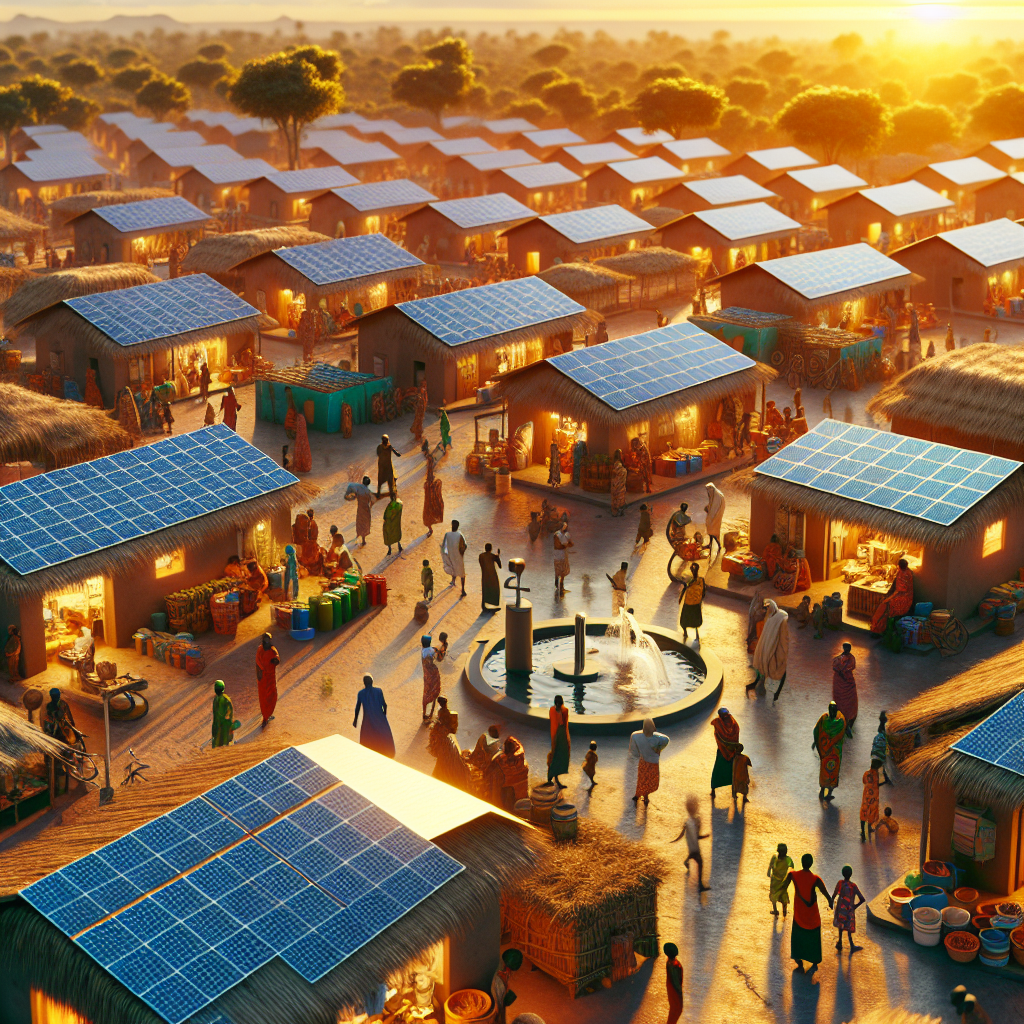
In recent news, LONGi’s activity in Africa has been selected as a sustainable brand case study by UNEP. This recognition highlights the importance of sustainable practices in the solar industry and showcases how companies can make a positive impact on both the environment and local communities. In this article, I’ll delve into what this means for the future of renewable energy in Africa and how we can learn from LONGi’s approach.
Table of Contents
- Introduction
- LONGi’s Impact in Africa
- Sustainability Practices
- Community Engagement
- Education & Empowerment
- Socioeconomic Effects
- Challenges Ahead
- The Future of Renewables in Africa
- Summary
- FAQs
- Sources
Introduction
As a strong advocate for clean energy, witnessing companies like LONGi champion sustainability on the African continent is both motivating and important. Africa faces numerous energy challenges, compounded by rapid population growth and economic development needs. Over 600 million people still lack access to electricity, according to the IEA, and millions more remain underserved. In this context, the arrival of companies with strong sustainability commitments and innovative business models can act as a catalyst for transformative change.
LONGi’s work is more than just installing solar panels; it aligns technological progress with deep, community-rooted engagement and responsible environmental stewardship. Throughout this article, I will explore the specific mechanisms that make their approach stand out, reflect on its broader significance for Africa’s clean energy future, and consider the key lessons for other stakeholders involved in the continent’s leap toward decarbonization.
LONGi’s Impact in Africa
LONGi, renowned as a global leader in the solar manufacturing industry, has made its mark in Africa by pursuing projects with both scale and purpose. Their commitment goes beyond simply delivering solar modules—they are fostering a lasting legacy anchored in responsible business and local engagement.
By establishing a supply chain of high-efficiency solar products tailored for African environments, LONGi addresses some of the continent’s most urgent issues: unreliable grid electricity, expensive diesel generation, and rural electrification. Their efforts prioritize off-grid and microgrid installations, empowering remote villages and peri-urban communities with power for schools, hospitals, farms, and small businesses. According to IEA’s Africa Energy Outlook, distributed solar solutions have the potential to reach millions faster and more cost-effectively than conventional grid extensions.
From a climate perspective, Africa’s energy transition heavily depends on replacing fossil-fueled generation with renewables. By bringing affordable, reliable, and sustainable solar to the table, LONGi is reducing dependence on diesel and coal while directly helping to meet global and continental emissions reduction targets. Their projects align with and advance the United Nations Sustainable Development Goals (SDGs), particularly Goal 7 (Affordable and Clean Energy), Goal 13 (Climate Action), and Goal 9 (Industry, Innovation, and Infrastructure).
Furthermore, the ripple effects go deeper: improving energy security enhances food production (by enabling irrigation and processing), supports critical services (like healthcare and education), and enables entrepreneurship—all of which are crucial for the socioeconomic transformation of Africa.
Sustainability Practices
What distinguishes LONGi is how sustainability is woven into every stage of its business. Solar manufacturing can itself be resource-intensive, but LONGi is recognized for its rigorous approach to minimizing environmental impacts across its operations.
The company has invested in cutting-edge techniques to produce high-efficiency monocrystalline silicon wafers and modules. High efficiency means more electricity generated per square meter, less land required, lower balance-of-system costs, and greater project viability—particularly important in settings with limited available infrastructure. In fact, LONGi was one of the first major solar firms to achieve net-zero manufacturing emissions in some factories.
In alignment with international standards, LONGi’s manufacturing achieves low water use, waste minimization, and greenhouse gas reduction through innovation in both product design and process engineering. Their supply chain emphasizes ethical sourcing—strictly avoiding conflict minerals and partnering with local firms where possible to boost positive spillovers.
LONGi’s environmental ethos extends to the end-user experience as well: their photovoltaic solutions are durable and require little maintenance, reducing the risk of e-waste and encouraging long lifespans even in demanding climates.
For more insights into why sustainable manufacturing matters and the types of benefits it brings, see this article on GreenBiz. The solar industry’s future depends on maintaining these high standards across the entire value chain—from raw material extraction to system recycling and repowering.
Community Engagement
Perhaps the most profound difference lies in LONGi’s approach to human-centered development. While technology transfer is critical, so too is meaningful engagement with the people whose lives will be directly impacted by the transition to solar.
LONGi’s methodology involves working hand-in-hand with local governments, traditional leaders, educational institutions, NGOs, and business associations. By soliciting input at every stage of the project lifecycle—from feasibility assessment through installation and ongoing operations—they ensure projects are matched to real needs.
For instance, battery-backed solar mini-grids have been tailored to power water pumps, cold storage, and mobile-phone charging hubs, addressing local priorities and creating new income streams. This participatory approach not only fosters acceptance and enthusiasm, but also helps build local capacity to maintain the equipment, thus ensuring sustainability beyond the initial deployment.
Engaging communities also means investing in awareness campaigns, training, and advocacy for gender inclusivity in renewable jobs—closing the gender gap in access to clean energy and in technical workforce training. According to Harvard Business Review, projects that prioritize genuine partnership outperform those imposed without understanding the cultural and economic fabric of their host regions.
Education & Empowerment
Education sits at the core of LONGi’s strategy—not only as a social good, but as an enabler of the entire energy transformation. Where conventional approaches might have dropped off after grid connection or system delivery, LONGi works with NGOs and education ministries to integrate solar and sustainability modules into local curricula. This instills early appreciation for renewable technology and equips the next generation of engineers, entrepreneurs, and citizens with the skills needed to thrive in a clean energy future.
They also partner with universities and technical institutes to offer hands-on training, internships, and practical apprenticeships. Such collaborations help close Africa’s sizeable skills gap in engineering, energy system planning, and entrepreneurship—the very fields essential to scaling up home-grown solutions. By planting roots in learning and capacity-building alongside infrastructure, LONGi ensures that technology transfer is coupled with enduring knowledge transfer. It’s a model of empowerment, not dependency.
Socioeconomic Effects
The socioeconomic impacts of access to stable, sustainable power can hardly be overstated. In rural towns where LONGi’s initiatives provide electrification, women are able to extend working hours in SMEs and local markets, children can study safely into the evening, health centers operate reliably, and clean water becomes increasingly accessible via powered pumps.
Affordable electricity unleashes new business models: phone charging, agro-processing, e-commerce, and light manufacturing flourish when reliable energy is provided, sparking economic resilience and local job creation. These opportunities are especially crucial in regions where erratic power has long stunted growth. Smallholder farmers benefit from solar irrigation, dramatically increasing yields and food security, while market vendors can store perishable goods thanks to affordable cold chain solutions.
CONTEXTUAL CASES: In East Africa, solar-powered clinics and maternal care units have led to marked improvements in health outcomes and reductions in maternal mortality. In West Africa, solar microgrids have enabled the rapid expansion of mobile money agents and Wi-Fi kiosks, bringing digital finance and connectivity to communities once considered off-limits to the digital world.
By making these advances accessible, LONGi is actively reducing inequalities within and among countries—a core aim of SDG 10.
Challenges Ahead
Despite these successes, the path is not without barriers. Developing renewable infrastructure in Africa is complex, shaped by persistent financing gaps, regulatory fragmentation, political uncertainty, and the need for massive investment in both grid and off-grid solutions. Affordability remains a critical challenge for the poorest households, and the up-front cost of high-quality solar technology can be out of reach without subsidies, climate finance, or innovative payment models.
LONGi, like its partners and competitors, must also navigate the risks of supply chain disruption, currency fluctuations, and extended timelines for project approvals. Ensuring system sustainability post-installation means building robust local capacity—requiring ongoing investment in training, spare parts supply, and technical support centers across diverse and remote geographies.
Yet these very hurdles are where partnerships with governments, donors, development banks, and civic groups become paramount. Collective action—leveraging proven expertise, blended finance mechanisms, and strong community involvement—can dissolve many of these bottlenecks, setting the stage for lasting impact.
The Future of Renewables in Africa
There’s an undeniable momentum at Africa’s back, with solar poised to become a mainstay of the continent’s future growth. Recent estimates by the African Development Bank suggest that renewables, principally solar, could account for up to 40% of electricity generation by 2030—as long as supportive policies, investment flows, and skilled workforces keep pace.
This vision is shared by regional energy ministers, cross-border power pools, the African Union, and grassroots energy entrepreneurs. While central grids remain vital for industrializing economies, solar mini-grids and rooftop installations will cover ground that conventional electrification simply cannot reach. Africa’s unique solar resource—the world’s best solar irradiation in many locations—offers a natural advantage for leapfrogging fossil-heavy development pathways.
Technological advances, such as integrated energy storage, smart metering, and digital payment platforms, are further making solar systems more reliable and affordable. Innovations like pay-as-you-go metering, pioneered in East Africa, are unlocking access for low-income users without the need for large up-front payments.
LONGi’s continued investment in R&D, local job creation, and industry partnerships bodes well for sustaining and scaling this momentum. Their model, as validated by UNEP’s sustainable brand recognition, sets an example for other global and African firms hoping to make a difference. For those interested in tracking this sector’s progress, updating with organizations like the African Development Bank regularly provides data, reports, and new financing opportunities.
Summary
LONGi’s recognition as a sustainability brand champion in Africa is not an isolated achievement. Rather, it reflects a broader movement—one in which purpose-driven business, community-led engagement, and relentless innovation converge to accelerate Africa’s clean energy revolution. By prioritizing durable, high-efficiency technologies and forging partnerships with local stakeholders, LONGi is proving that commercial success and positive social and environmental impact can go hand-in-hand.
Their approach offers many important lessons. First, that technology transfer without community empowerment offers only limited impact. Second, that investing in education and technical training is as important as grid connection or module installation. Third, that sustainability demands thinking across the value chain—from ethical manufacturing and transparency to responsible project decommissioning and recycling.
As governments, development partners, and private investors rally around Africa’s solar opportunity, the LONGi story is one to watch—and one to learn from. Collectively, these advances bring the continent a step closer to realizing both universal electrification and a just, sustainable energy transition.
FAQs
- What is LONGi’s main focus in Africa? LONGi focuses on providing sustainable solar energy solutions to underserved communities, with a particular emphasis on high-efficiency products, microgrid and mini-grid installations, and community empowerment initiatives.
- How does LONGi engage with local communities? LONGi partners with governments, local NGOs, and residents to tailor projects to genuine needs. They also invest in education, training, and awareness-building to create local capacity to manage and maintain new solar systems.
- What are the main benefits of solar energy in Africa? Solar energy delivers clean, reliable, and affordable electricity—enabling improved education, healthcare, entrepreneurship, agricultural productivity, and ultimately, economic development. It also reduces reliance on fossil fuels and helps address climate change.
- What challenges remain for solar expansion in Africa? Key challenges include financing, affordability for the poorest households, policy and regulatory barriers, supply chain risks, and the need for ongoing investment in local technical skills and system maintenance.
- How can I learn more about renewable energy initiatives in Africa? Track updates from impactful institutions like the African Development Bank, IEA, and Harvard Business Review for the latest research, project highlights, and in-depth field reporting.